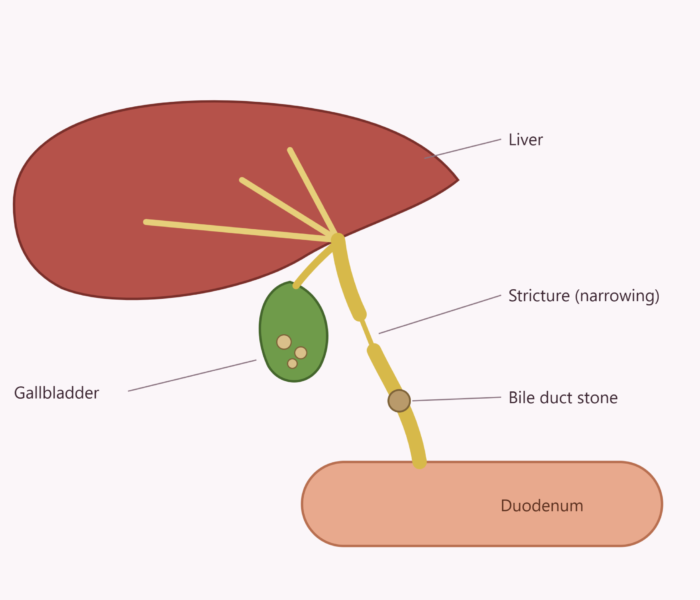
Introduction
Bile duct stones, also known as choledocholithiasis, occur when gallstones move from the gallbladder into the common bile duct. These stones can block the flow of bile, causing jaundice, abdominal pain and, in some cases, serious infections such as cholangitis or inflammation of the pancreas. Bile duct strictures, which are narrowings of the bile duct, can also obstruct bile flow. Early diagnosis and appropriate treatment help prevent complications.
Symptoms
- Yellowing of the eyes and skin (jaundice)
- Dark urine and pale stools
- Pain in the upper right abdomen
- Fever and chills
- Nausea and vomiting
- Itching and loss of appetite
Diagnosis & Treatment
Diagnosis may involve blood tests, ultrasound, MRCP, endoscopic ultrasound (EUS) or other imaging investigations.
Treatment depends on the cause and severity of the blockage. ERCP (Endoscopic Retrograde Cholangiopancreatography) is a specialized endoscopic procedure used to remove bile duct stones. It may also help treat certain strictures through procedures such as balloon dilation or stent placement. Additional treatment may be needed depending on the underlying cause.
Why Choose Dr. Prasad Bhate?
Dr. Prasad Bhate is a gastroenterologist in Pune with experience in diagnostic and therapeutic endoscopy. He evaluates bile duct conditions and helps determine suitable investigations and endoscopic treatment options based on each patient’s condition.
Recent Research Data
Clinical guidelines recommend endoscopic or other appropriate bile duct clearance for confirmed common bile duct stones, with treatment selected according to the patient’s clinical condition and risk factors.
FAQs
- What are bile duct stones?
They are stones that form in the gallbladder and move into the common bile duct, or stones that develop within the bile ducts. - Can bile duct stones cause jaundice?
Yes. They can block bile flow and cause obstructive jaundice. - What is ERCP?
ERCP is an advanced endoscopic procedure used to diagnose and treat certain bile duct and pancreatic duct conditions, including stone removal. - Are bile duct stones dangerous?
They can cause complications such as bile duct infection (cholangitis) or pancreatitis if left untreated. - Can bile duct strictures be treated with ERCP?
Some strictures can be managed with ERCP using techniques such as balloon dilation and stent placement. Treatment depends on the cause and location of the narrowing.
Recent Research Data
The American Society for Gastrointestinal Endoscopy (ASGE) recommends using liver function tests and imaging to assess suspected bile duct stones. For patients with an intermediate likelihood of stones, MRCP or EUS can help confirm the diagnosis before ERCP. ERCP is an established treatment for bile duct stone removal, but it carries potential risks and should be used when clinically indicated.
FAQs
1) What are bile duct stones?
Ans: They are stones that form in the gallbladder and move into the common bile duct, or stones that develop within the bile ducts.
2) Can bile duct stones cause jaundice?
Ans: Yes. They can block bile flow and cause obstructive jaundice.
3) What is ERCP?
Ans: ERCP is an advanced endoscopic procedure used to diagnose and treat certain bile duct and pancreatic duct conditions, including stone removal.
4) Are bile duct stones dangerous?
Ans: They can cause complications such as bile duct infection (cholangitis) or pancreatitis if left untreated.
5) Can bile duct strictures be treated with ERCP?
Ans: Some strictures can be managed with ERCP using techniques such as balloon dilation and stent placement. Treatment depends on the cause and location of the narrowing.
Consult Dr. Prasad Bhate for expert evaluation and treatment of bile duct stones and strictures in Pune.
Balewadi Clinic: Expert Superspeciality Clinic, 3rd Floor, Near Lakshmi Mata Mandir, Balewadi Gaon, Pune – 411045.
Pimpri-Chinchwad Clinic: Gera Imperium Oasis, B-209, Near Finolex Chowk, Morewadi, Pimpri Colony – 411018.
Appointment: +91-7770082211